
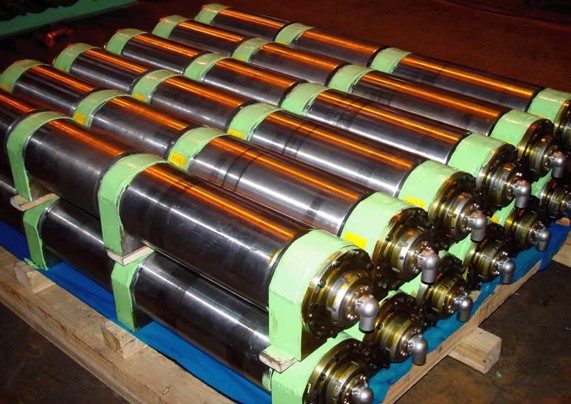
In continuous casting, roller assemblies support and guide the strand while it solidifies and passes through the caster. They operate in a high temperature, high moisture environment with scale, water spray, and cyclic mechanical load. Because the roller assembly defines strand support and alignment, its condition affects bulging control, strand tracking, and the stability of casting operation.
A roller assembly is more than a roll body. It includes journals, bearings, seals, and mounting interfaces that integrate with segment structures. In service, the most common operational risks are bearing overheating, seal failure leading to water ingress, and misalignment that changes the effective roller gap. Even small deviations in runout or journal geometry can raise bearing load and contribute to vibration or uneven wear across a segment.
From a purchasing and technical standpoint, confirm the design interfaces first: segment position, strand size, and mounting requirements. Then confirm manufacturability: material selection, heat treatment route where applicable, machining accuracy of journals and bearing seats, and documented inspection for runout and critical dimensions. For casting operations, repeatability matters. The ability to interchange assemblies across segments and maintain consistent roller gap reduces maintenance time and lowers downtime risk.
A reliable supplier should provide traceable inspection records tied to the roller assembly ID. Useful documents include dimensional reports, bearing and seal specifications, and interface confirmation against the drawing revision. If your plant has known issues such as seal wear or bearing contamination, include those observations during the quotation stage so the manufacturing and inspection plan can address the real failure drivers.
For acceptance, require a dimensional report that references the drawing datums, records the measured values for critical interfaces, and ties all results to the part serial number. This makes inbound inspection faster and supports long term spare parts management and failure analysis.
For acceptance, require a dimensional report that references the drawing datums, records the measured values for critical interfaces, and ties all results to the part serial number. This makes inbound inspection faster and supports long term spare parts management and failure analysis.
Suggested secondary keywords: continuous caster roller assembly, metallurgical equipment parts, heavy-duty machining, inspection.
about
avada factory
Sempery ultricies nibh at dolor cras urna eleifend nec. Atiam efficitur tempor.