
When it comes to engineering for the nuclear sector, there is no margin for error. As a professional industry blogger, I often discuss components that form the backbone of heavy industries, but few are as critical as the Sector Plate for Nuclear Power Equipment. This specific component plays a vital role in the structural integrity and safety protocols of nuclear facilities.
In this article, we will explore the manufacturing standards required for such high-stakes components and how integrated production lines ensure quality. For those seeking a reliable source for this technology, you can explore the specifications of the Sector Plate for Nuclear Power Equipment currently available.
The Critical Demands of Nuclear Component Manufacturing
Manufacturing parts for nuclear power isn’t just about shaping steel; it is about guaranteeing performance under extreme conditions for decades. A Sector Plate must withstand immense weight, potential seismic activity, and harsh environmental conditions without failure. This requires a manufacturing philosophy that prioritizes “Zero-Defect” processes from the very first cut of the raw material.
The key challenges in producing a reliable Sector Plate include:
- Dimensional Stability: The geometry of the plate must remain unchanged under heavy loads to ensure the alignment of connected machinery.
- Welding Integrity: Any structural flaw in the welds can compromise the safety of the entire system.
- Material Toughness: The steel used must resist fatigue and maintain ductility over the lifespan of the plant.
Meeting these demands requires a level of control that is only possible when every process, from cutting to final inspection, is managed under one roof.
The Integrated Workshop Advantage
The journey of creating a nuclear-grade Sector Plate is a testament to modern heavy-plate processing capabilities. It begins with the selection of high-grade heavy plates and proceeds through a rigorous sequence of operations.
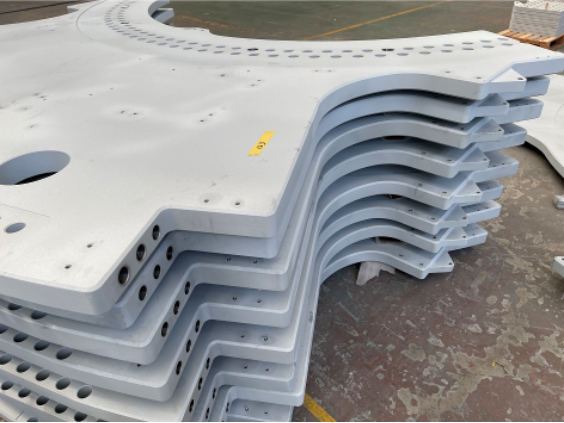
Let’s break down the key stages that ensure the Sector Plate for Nuclear Power Equipment meets the stringent requirements of the nuclear industry:
- Precision Cutting: The process starts with a 20kW laser cutting system. This ensures that the initial plates are cut with micron-level accuracy, which is the foundation for a perfect final fit.
- Heavy Forming: To shape the robust structure, a 10,000-ton hydraulic press is utilized. This allows for the bending and rolling of plates up to 280mm thick, ensuring the structural rigidity required for nuclear applications.
- Advanced Welding: The assembly involves multi-process welding, including MIG, TIG, and submerged arc welding. These processes are performed by ISO9606 certified welders to guarantee that the structural integrity is never compromised.
- Gigantic Machining: The final shape is achieved using massive gantry milling machines capable of handling workpieces up to 6.5m × 24m. This allows for the machining of large, heavy parts in a single setup, minimizing the risk of error.
Verification: The Data-Driven Approach to Safety
In the nuclear industry, “trust but verify” is not just a saying; it is a protocol. You cannot simply assume the plate is flat; you must prove it with data.
This is where the verification process becomes critical. Leading manufacturers utilize Zeiss CMM (Coordinate Measuring Machines) and Hexagon laser trackers to provide acceptance-ready data. This means that before the component leaves the factory, you receive a digital dossier confirming its flatness, bore position, and dimensional accuracy.
For project managers and engineers looking to upgrade their facility’s safety infrastructure, sourcing this component from a partner with full-process mastery is the smartest move you can make. Explore our capabilities further by visiting the product page for the Sector Plate for Nuclear Power Equipment.
2 Comments
Leave A Comment
about
avada factory
Sempery ultricies nibh at dolor cras urna eleifend nec. Atiam efficitur tempor.

Finally found a casino app that actually works smoothly on my phone without any lag. The bonus structure is fair and I love how transparent the rules are. My friends and I are all hooked on the live dealer games now. You should give phwin36e a try
This platform just feels right for someone like me who plays on the move. The app runs smooth and I get my bonuses without any wahala. The support guys are patient and always ready to help you sort things out. Really solid choice. merdeka138login